WhatsApp Marketing: The Complete Playbook for Businesses (2026)
The complete WhatsApp marketing playbook: build a consented list, write messages that get replies, pace your sends, and measure what actually matters.
WhatsApp is where your customers already are, every day, reading messages from the people they care about. Used properly, it is the most direct marketing channel a business can have: personal, immediate, and measurable. Used badly, it is the fastest way to get your number blocked by the very people you wanted to reach.
This playbook is the complete version of the first kind. It walks through the whole system we use and build for: earning the list, writing the message, choosing the moment, running the infrastructure, and reading the results. It is written from operating experience, not theory - we build Automate, a WhatsApp campaign manager, and we run campaigns on the same kind of dedicated setup our customers get.
What WhatsApp marketing actually is
WhatsApp marketing is the practice of sending targeted, permission-based messages to your customers on WhatsApp: offers, announcements, reminders, and follow-ups, delivered into the one inbox people check more than any other.
It is worth being precise about what it is not, because a lot of what calls itself WhatsApp marketing online is just spam with extra steps. It is not buying a database of phone numbers and blasting it until the number dies. It is not forwarding the same message to 500 contacts from your personal phone. And it is not a chatbot playground where automation replaces the conversation.
The distinction matters commercially, not just ethically. WhatsApp shows senders, in ways users can see, whether messages are wanted: blocks, reports, and replies are all signals. A campaign to people who asked to hear from you gets read, answered, and clicked. The same creative sent to strangers gets the number restricted. Everything else in this playbook is downstream of that one fact.
Why are businesses moving budget to WhatsApp?
Three properties make WhatsApp worth a line in your marketing plan that email alone cannot claim.
It is where attention already lives. More than two billion people use WhatsApp every month, by Meta’s own reporting, and in markets like India, Brazil, Southeast Asia, and much of Europe and Africa it is the default way business and personal life actually happens on a phone. You are not asking customers to open a new app or find your email between promotions. You are arriving where they already are.
It is conversational by default. An email is a broadcast that can be answered with effort. A WhatsApp message is a message - the reply button is right there, and people use it. For a business, that changes what campaigns can do: a site-visit invitation gets an actual “yes, Saturday works”, a payment reminder gets a question you can answer, and a catalog gets forwarded to the family member who decides these things.
Receipts are visible. WhatsApp tells you, per message, whether it was delivered and read. That is a level of per-recipient feedback email marketers spent two decades approximating with tracking pixels. It also keeps you honest: when a message pattern stops getting read, you know quickly.
None of this means email is dead or that WhatsApp replaces it. It means that for time-sensitive, personal, high-attention messages - offers, reminders, confirmations, re-engagement - WhatsApp routinely outperforms on both attention and response.
The four building blocks of a campaign that works
Every campaign we have seen succeed stands on the same four blocks. Weakness in any one of them caps the results of the other three.
1. A consented list. People who opted in, with a record of when and how. This is the foundation, and it is also the part that protects you legally under data protection laws like India’s DPDP Act and the EU’s GDPR.
2. A message worth receiving. Personalized, short, and clear about the one thing you want the reader to do. Personalization here is not a gimmick - it is what separates a message from a blast.
3. Infrastructure you control. Where and how your messages are sent: which number, which server, which IP address, at what pace. This is the block most businesses never think about until something breaks.
4. Timing and restraint. The right hours, the right frequency, and the discipline to send less than you could. The best campaign engine in the world cannot save a number that messages people at midnight.
The rest of this playbook takes each block in turn.
Building a list people actually gave you
Your list is the asset. Everything else - the tool, the templates, the timing - is applied to it.
Collect opt-ins at every real touchpoint. The sources that produce contacts who actually read messages: checkout and billing counters, with a line on the receipt or a QR code; your website and online store, with a checkbox next to the phone field; WhatsApp itself, when customers message you first and you ask to keep them updated; in-store signup cards; and booking or appointment flows, where order updates open the door to marketing consent.
Never buy contacts. Purchased and scraped lists are prohibited under our Acceptable Use Policy, and they are prohibited on WhatsApp itself - the WhatsApp Terms of Service and the Commerce Policy both bar messaging people who did not agree to hear from you. Purchased lists produce the worst possible sending pattern - high volume, low engagement, high blocks - which is precisely the pattern that gets numbers restricted. They also create a legal problem, because you cannot show consent you never collected.
Clean the list as part of every import. Duplicates, malformed numbers, and dead entries are not neutral; they distort your engagement metrics and waste allowance. Import from CSV with dedupe and validation on - in Automate both run automatically on upload - and remove numbers that bounce repeatedly.
Tag at the point of capture. A column that says where the contact came from, or what they bought, is what turns a broadcast list into segments. The difference between “festival offer to everyone” and “festival offer to people who bought last quarter” is the difference between a campaign and noise, and it costs one extra spreadsheet column.
Segmentation without a marketing degree
Segmentation sounds like enterprise software talk. In practice it is one question asked before every send: “who should this message not go to?”
Three splits cover most of the value, and every business already has the data for them in a spreadsheet:
By what they bought. A product launch goes to people who bought that category. Everyone else gets the next announcement that actually concerns them - not this one.
By recency. Contacts who transacted in the last 90 days are a different audience from contacts who went quiet a year ago. The same offer deserves different framing for each, and produces different results.
By source. People who met you at an exhibition tolerate different messages than people who checked out online last week. Tagging the source column at import is what makes that distinction usable later.
Implementation is deliberately boring: extra columns in the CSV, one import per segment, one campaign per import. Dedupe and validation run on every upload, so the cleanliness is handled; the discipline is in the export. It pays: a focused campaign to the right 2,000 people consistently outperforms the same message diluted across 20,000.
Writing messages that get read and answered
WhatsApp messages are read on a small screen, in a crowded chat list, in seconds. Write for that reality.
Lead with the point. The first line decides whether the message gets expanded at all. Offer, deadline, or news - front-load it.
Keep it short. Most campaign messages belong under 300 characters: the offer, the one detail that makes it matter, and the action. Attach the catalog or brochure as a PDF rather than describing it in text.
Personalize past the name. A name token is table stakes. What actually lifts replies is context: the product they bought, the city they are in, the appointment they booked. Even simple segmentation - “you shopped with us last month” - reads as memory, and memory reads as respect.
Use spintax so no two messages are identical. This is the part most senders miss. When 5,000 contacts receive the same message, word for word, the pattern is visible to everyone - recipients, platforms, everyone. Spintax lets you write the variations once:
{Hi|Hey|Hello} {name}! Our festive sale {starts tomorrow|begins this weekend}. Show this message {in store|at checkout} for an extra 10% off.
Every recipient gets one variant, assembled per contact, so each message reads like it was written for them - because, in effect, it was. Our personalization engine does this per recipient automatically, and it is the single highest-leverage feature in campaign tooling that nobody talks about.
One message, one action. A message with three links gets zero taps on the one you wanted. Decide the single next step - reply, tap, visit, or show this message - and cut everything that competes with it.
Make opting out effortless and safe. A reply of “stop” gets honored, immediately, no dark patterns. People who can leave easily stay longer and complain less, and complaint-free sending is what keeps a number healthy.
Six campaign types to run first
Not every campaign needs inventing. Six patterns cover most of the value for a small business or agency:
| Campaign | What it does | When it works |
|---|---|---|
| Limited-period offer | Time-boxed discount or festive deal with one action | Festivals, weekends, clearing seasonal stock |
| New arrival or restock | Announcement to past buyers of that category | When your list already knows the product |
| Appointment or service reminder | Reduces no-shows with a confirm-and-reschedule option | Clinics, salons, studios, site visits |
| Payment and due-date reminder | Friendly nudge with the amount and a payment link | Instalments, subscriptions, memberships |
| Win-back | A reason and an incentive to come back after 60-90 days quiet | Contacts who went silent, not unsubscribed |
| Event and launch invite | Details plus an RSVP reply prompt | Store openings, webinars, launches |
Two notes from running these at scale. First, reminders and announcements consistently earn the best engagement of anything a business sends - use them to establish your baseline before the bigger promo pushes. Second, the win-back needs a reason to exist beyond “we miss you”: a genuine offer, a change, or news. Silence plus a discount reads as exactly what it is. For fifteen of these written out as paste-ready spintax templates, see WhatsApp campaign examples with the actual messages; for industry-specific systems, the retail and ecommerce, real estate and education and coaching playbooks each start from that industry’s own touchpoints.
Timing, pacing, and quiet hours
The same message succeeds at 11 AM and fails at 11:30 PM. Timing is not a detail; it is part of the message.
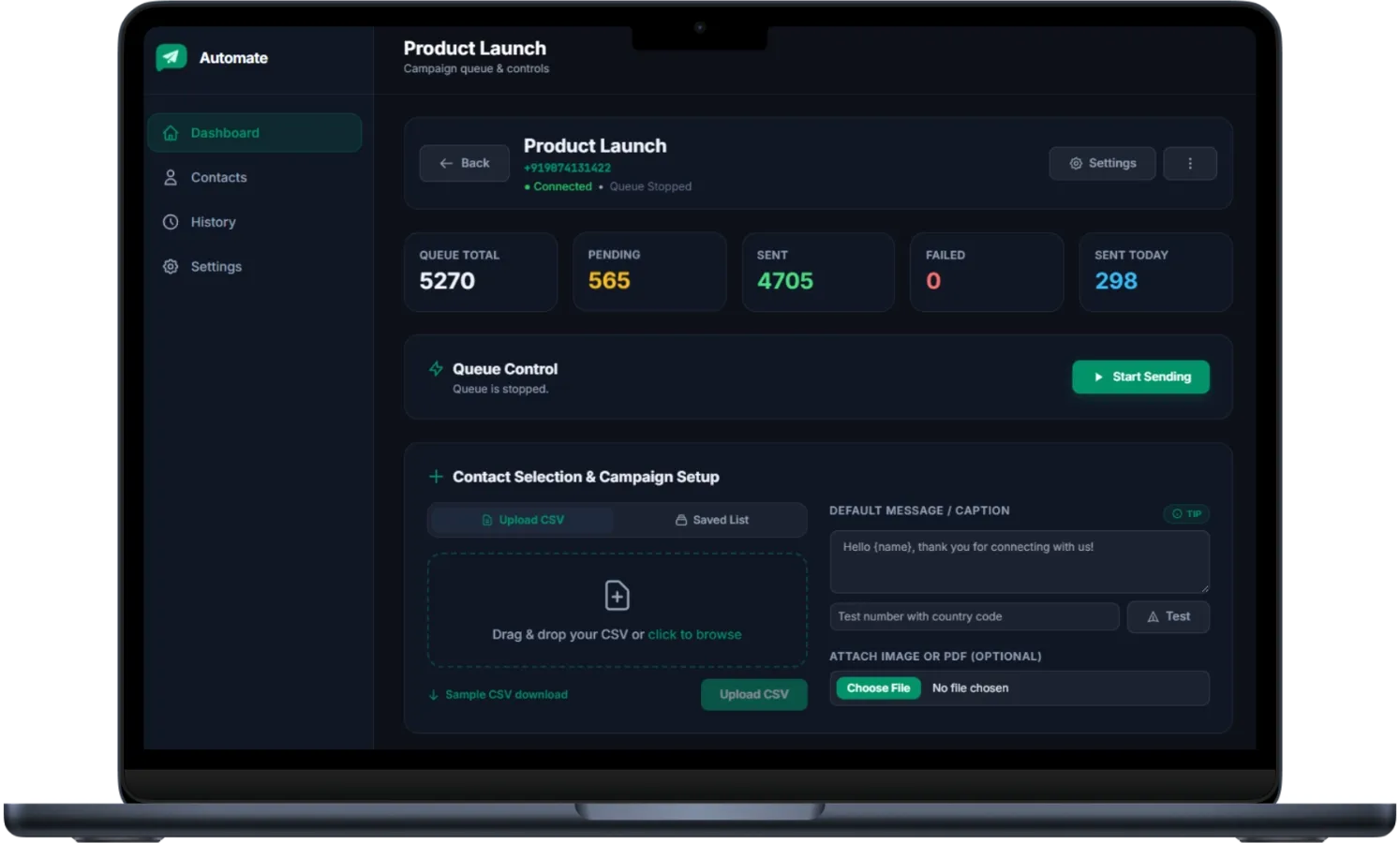
Send inside waking hours, always. Automate enforces quiet hours by default, from 10 PM to 8 AM, and we would enforce them even if we could not - a midnight promotion is not a campaign, it is a reason to block your number.
Match the moment to the message. Offers work late morning and early evening when people browse. Reminders work a day before, then an hour before. Payment nudges work just after salary week. Your own read receipts will teach you your audience faster than any best-practice chart - watch when your reads cluster and schedule there.
Ramp volume like a person, not a machine. A number that sent 200 messages last week should not send 20,000 this week, even if the tool allows it. Engagement signals - replies, reads, absence of blocks - need time to accumulate and vouch for you. This is why new numbers in Automate start at 20 messages a day in warm-up and grow about 1.6x daily: the ramp is the protection. Grow in steps, and let the metrics invite the next step. The number warm-up schedule maps the full ramp day by day, and what actually constrains a send covers the ceilings that apply even to a warmed-up number.
Cap frequency. However good your content, a contact who hears from you every second day stops hearing from you at all. For most businesses, two to four campaigns a month is the ceiling worth staying under, with transactional reminders on their own, expected schedule.
Where your messages are sent from matters
This is the block almost nobody thinks about, and it is where cheap tools quietly fail you.
When your campaigns leave a shared server - the way most low-cost senders run - your messages depart from the same infrastructure as everyone else’s. Their volume spikes, their complaint rates, and their sloppy list hygiene all sit on the same IP address and the same sending reputation as your campaigns. You can do everything right and still inherit a penalty earned by a stranger.
That is why Automate provisions every customer a dedicated VPS with a private, isolated IP. Your campaigns leave from infrastructure nobody else touches, so nobody else’s behavior can tax your deliverability, and your contact data lives on your server, not in a shared database.
The honest boundary: infrastructure isolates you from other senders. It cannot isolate you from yourself. A dedicated IP sending unsolicited messages is just a privately owned spam problem. The infrastructure block works only on top of the consent block - which is exactly the order this playbook gave them. For the full anatomy of what actually triggers enforcement, see why WhatsApp numbers get restricted.
Measuring what actually happened
WhatsApp gives you feedback email marketers dream about, if you read it at the right level.
Delivery rate tells you the list is clean and the number is healthy. A sudden drop is your earliest warning - investigate before sending again.
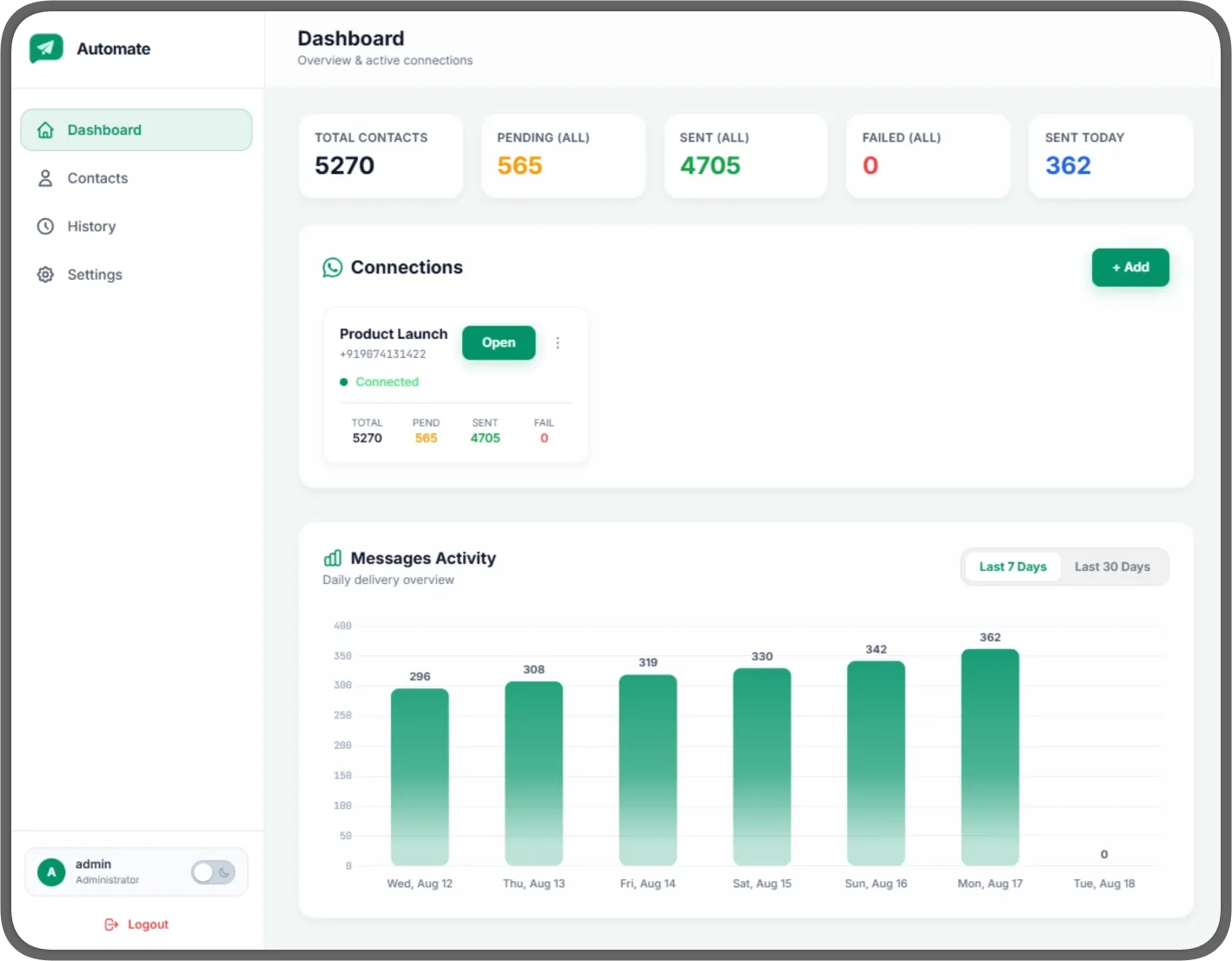
Read rate tells you the message earned attention. WhatsApp read receipts show you, per contact, whether the message was opened. Watch it per campaign, not just on average: the spread between your best and worst campaigns is your creative education.
Replies and clicks are the numbers that pay for the channel. A reply to a site-visit invite, a tap on a payment link, a “yes, size M please” - these are the conversions, and they are countable. Tag links with UTM parameters where they lead to your site so revenue attribution lands in your analytics.
Block and opt-out rate is the number that protects all the others. A rising block rate is the channel telling you the frequency or the relevance is wrong. Treat any spike as a stop signal, fix the cause, and resume.
One discipline ties it together: record every campaign’s numbers in the same place - send size, hour, template, read rate, replies. After ten campaigns you will know things about your audience no benchmark report can tell you.
What running this costs
Three cost models exist, and knowing which one you are in matters more than any headline price.
Per-message API pricing is the official route: each delivered template message is billed by category and country - Meta moved from conversation-based billing to this model in July 2025, per the official WhatsApp Business Platform pricing docs - on top of a provider’s platform fee and often a markup. Spend rises with every send, forever, and a festive-season campaign plan means estimating a bill, not reading one.
Flat-rate pricing is the model we chose: $15, $20, or $30 a month billed yearly ($180, $240, $360), each tier covering a fixed monthly message allowance on a dedicated server. Your cost is decided when you subscribe, not when you hit send. The plans are on the pricing section, and the true cost of WhatsApp marketing compares all three models with worked numbers.
Free tools are worth exactly what they cost: shared infrastructure, no isolation from other senders, and no one accountable when the number dies.
Then factor in the line item nobody budgets for: a restricted number means reprinting every QR code, re-earning every opt-in that followed it, and weeks of careful rebuilding. Infrastructure that protects the number is cheaper than replacing one - that comparison is the real price of the channel.
The seven mistakes we see most often
- Buying contacts. It fails everywhere, all at once: legally, at the platform, and commercially.
- Sending identical copy to thousands. The same-message-at-scale pattern is the signature of a blast. Spintax exists; use it.
- Ramping volume faster than engagement grows. The fastest route from a healthy number to a restricted one.
- Ignoring quiet hours. One midnight campaign costs more reputation than ten good ones earn.
- No opt-out path. Trapping people does not retain them; it converts them into block reports.
- Frequency without memory. Campaigns that ignore what a contact last received read as noise, and noise gets muted.
- Measuring only delivery. Delivered is the floor, not the result. If nobody replies or clicks, the campaign did not happen.
Your first week, planned out
A concrete starting sequence, assuming a list of opt-ins already collected. If you would rather follow the click-by-click version with screenshots, the step-by-step campaign walkthrough covers the same flow inside the product:
Day 1-2. Export your contacts to CSV. Clean it: dedupe, validate numbers, add a source column. Import to your campaign tool and let validation flag the rest.
Day 3. Write one short announcement - an offer, a restock, or a reminder
- with name personalization and two or three spintax variants on the opener. Attach your catalog as a PDF if you have one.
Day 4. Send to your warmest 10-15%: recent buyers, recent replies. Morning or early evening, inside quiet hours. Watch reads and replies land.
Day 5-7. If engagement holds, step up to the next segment. If blocks or mutes appear, stop and fix the message or the segment before continuing. Record every number.
That is the whole playbook at small scale: consent, personal message, reasonable pace, honest measurement. Scale is just repetition with better data - and if you want an infrastructure that grows with it, how Automate works is a two-minute read, or you can see the plans and order directly.