The True Cost of WhatsApp Marketing in 2026
What WhatsApp marketing costs in 2026: per-message API rates and provider markups versus flat yearly pricing, with worked examples at real campaign volumes.
Ask what WhatsApp marketing costs and you will usually get a rate card answer: so much per message, so much per month. That answer is incomplete in a way that costs businesses real money every year, because the rate card is only one of three models - and it is rarely the one doing the most damage or the most good.
This guide prices all three honestly, with worked examples at real campaign volumes, the costs nobody quotes, and a plain statement of which model fits which business. The numbers here use Meta’s published rates and our own plan sheet - nothing invented, and where rates vary by country, the ranges say so.
The three cost models
Every way of running WhatsApp campaigns in 2026 falls into one of three billing shapes:
| Model | How you pay | Who it fits |
|---|---|---|
| Official API (per message) | Metered per delivered message, by country and category, plus platform fees and markups | Support-heavy teams on official rails |
| Flat-rate campaign tools | One fixed yearly price covering a monthly allowance | Campaign-focused businesses with their own lists |
| Free and cheap blasters | Little or no money up front | Nobody, once the real bill arrives |
The next three sections take them in order, and the worked examples then put real numbers on each.
Model 1: official API, per-message pricing
The official route prices messages the way a utility prices electricity: each delivered template message is billed at a rate set by its category - marketing, utility, or authentication - and the recipient’s country. Meta moved to this model from conversation-based pricing in July 2025, and charges apply on delivery, not on send.
Two structural things matter more than any single rate. First, the rates are the floor, and they live on Meta’s official pricing page - metered by category, mapped to the recipient’s country code, and revised over time. Second, metered billing makes every budget an estimate: API access usually arrives through a Business Solution Provider, whose platform subscription and per-message markup ride on top of Meta’s rates, and a festive campaign is not just work to plan - it is a variable cost you approve retroactively.
None of this makes the API a bad product. It makes it a metered product, and metered products reward a specific kind of usage: low campaign volume, heavy two-way conversation, utility messages inside free windows. Businesses whose usage looks like that can genuinely pay little. Campaign-heavy businesses will watch the meter run.
Model 2: flat-rate campaign tools
The second model prices the outcome, not the count: one fixed price for a defined monthly allowance on defined infrastructure.
Automate is this model. Three plans - Starter, Growth, Enterprise - at $15, $20 and $30 per month effective, billed yearly as $180, $240 and $360. Each covers a fixed monthly allowance (15,000, 37,000 or 75,000 messages), a number of connected lines (2, 5 or 10), and a dedicated VPS with a private IP. There are no per-message fees and no usage surcharges.
What the flat price buys is not just the allowance. It is the certainty of knowing the year’s spend on day one, which is what lets a business run the extra festive campaign or the win-back sequence without wondering what it will bill. And because every account sits on isolated infrastructure, the price includes the deliverability insulation that shared servers cannot offer - the infrastructure section explains why that line item earns its keep.
Every plan carries the same capability set, so the tiers differ only in allowance and line count: the personalization engine with spintax, PDF and media attachments, the quiet-hours scheduler, onboarding and migration help, and the dedicated VPS with private IP underneath it all. A cheaper tier can be the right answer, but a smaller feature set is never the trade you are making.
Model 3: free and cheap blasters
The third model is the one with no rate card at all: free tools, cracked tools, and dirt-cheap blasters that run everyone from shared servers.
The sticker price is real - they cost little or nothing. So is everything that rides with it: your messages leave from the same infrastructure as every other customer’s, your number shares their reputation, your contact list sits in a shared database, and nobody is accountable when the sending pattern gets your number restricted. The restricted-numbers guide prices that outcome honestly: reprinting every QR code, re-earning every opt-in, and weeks of careful rebuilding.
A number with a clean history and a consented list behind it is an asset you already paid for. Choosing a sending model that puts it at risk to save a few dollars a month is the most expensive line item in this entire guide.
Worked examples at real volumes
The table below compares annual costs at three realistic monthly campaign volumes. The API figures are illustrative, using Meta’s published marketing rates of about $0.025 per delivered message in North America and about $0.013 in India, before platform fees and provider markups - which only push the metered figures higher. Rates vary by country and change over time, so treat these as honest ballparks, not quotes.
| Monthly campaign volume | Official API (North America) | Official API (India) | Automate flat rate |
|---|---|---|---|
| 10,000 messages | ~$3,000/yr | ~$1,560/yr | $180/yr (15,000/mo allowance) |
| 37,000 messages | ~$11,100/yr | ~$5,772/yr | $240/yr (37,000/mo allowance) |
| 75,000 messages | ~$22,500/yr | ~$11,700/yr | $360/yr (75,000/mo allowance) |
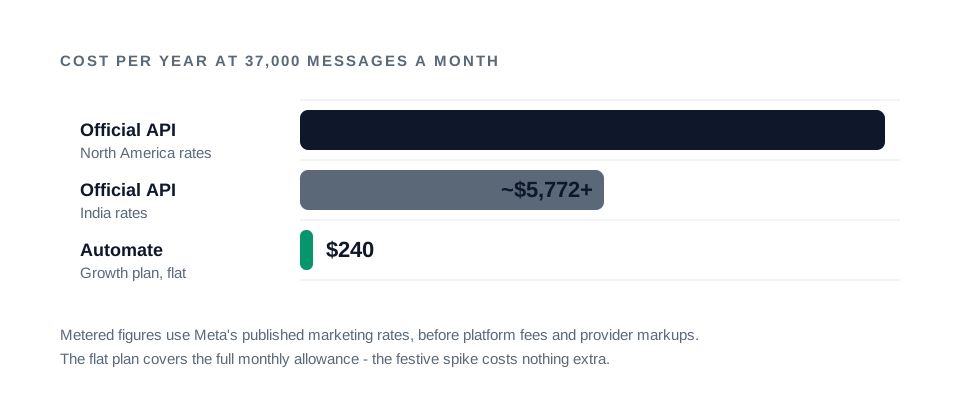
Read the table for its shape, not its decimals. Metered costs scale in a straight line with your ambition: the festive campaign that doubles your volume doubles your bill. The flat rate is a staircase you chose in advance - and the gap widens exactly when a business is succeeding.
Reading one row aloud, to show the arithmetic is honest: a business sending 37,000 campaign messages a month at North America rates watches the meter read about $925 for that month, roughly $11,100 across the year, and the provider’s platform fee and markup arrive on top. The same twelve months on the Growth plan are $240, decided the day of subscribing, whatever the campaign calendar does.
Two honest footnotes. India’s lower rates narrow the gap at low volumes, so a business sending one small campaign a month to an Indian audience should run its own numbers before concluding. And the API figures exclude provider platform fees and markups, which typically add tens of dollars a month and push the metered totals further up, not down.
The hidden costs nobody quotes
Beyond the billing model, four costs shape the real annual figure:
Template approval overhead. The official API requires every message template to be approved before use - writing, submitting, waiting, and re-submitting after edits. For a campaign-heavy business, that is a standing tax on agility.
Peak-season uncertainty. Metered pricing turns your best months into your most expensive ones, precisely when budgets deserve predictability. Flat pricing turns the festive spike into a non-event.
Provisioning time. Full honesty includes our own model’s cost: Automate instances are custom-built per customer, so credentials arrive within about two days rather than instantly, and the commitment is yearly. That is the trade for dedicated infrastructure at this price - self-serve and dedicated rarely share a price tag.
The number itself. Covered above because it dwarfs the rest: whatever the monthly saving from a risky sending setup, it is priced against an asset that takes months to rebuild.
Which model fits your business
The API route fits teams whose WhatsApp usage is dominated by two-way support and chatbot conversations, who need the official rails for integration reasons, and whose campaign volume is low enough that metered rates stay tame.
Flat-rate campaign tools fit businesses whose usage looks like campaigns: offers, announcements, reminders and win-backs to a list they own, at volumes that would make a meter sprint. If that is you, the plans and pricing are one screen, and the how-to walkthrough shows the whole flow from list to results. For the wider decision - not just price but infrastructure, contracts and ownership - the software buyer’s guide walks the full framework, and how WhatsApp marketing tools actually price dissects the quote structures providers use.
Free and cheap blasters fit nobody who plans to still be sending next year.
Whichever way you lean, price the year, not the message - and include the cost of the number in the calculation. It is the one asset in this channel you cannot buy back at any rate.
Before signing with any provider, on either metered or flat terms, five questions separate the honest quotes from the hollow ones:
- What exactly is billed - deliveries or sends, and which categories?
- What does the platform fee include, and what is marked up on top?
- What happens to my bill in my busiest month?
- Where do my messages physically leave from - shared or dedicated?
- Who do I email when something breaks, and how fast do they answer?
A provider who answers those plainly has already told you most of what the rate card leaves out.